Professor Ron Wakkary visits GSA’s School of Innovation & Technology
In his lectures, he introduced students to the ideas underpinning his most recent design research, inviting them to consider how design might move beyond human-centred assumptions and towards more relational, cohabitable, and accountable practices.
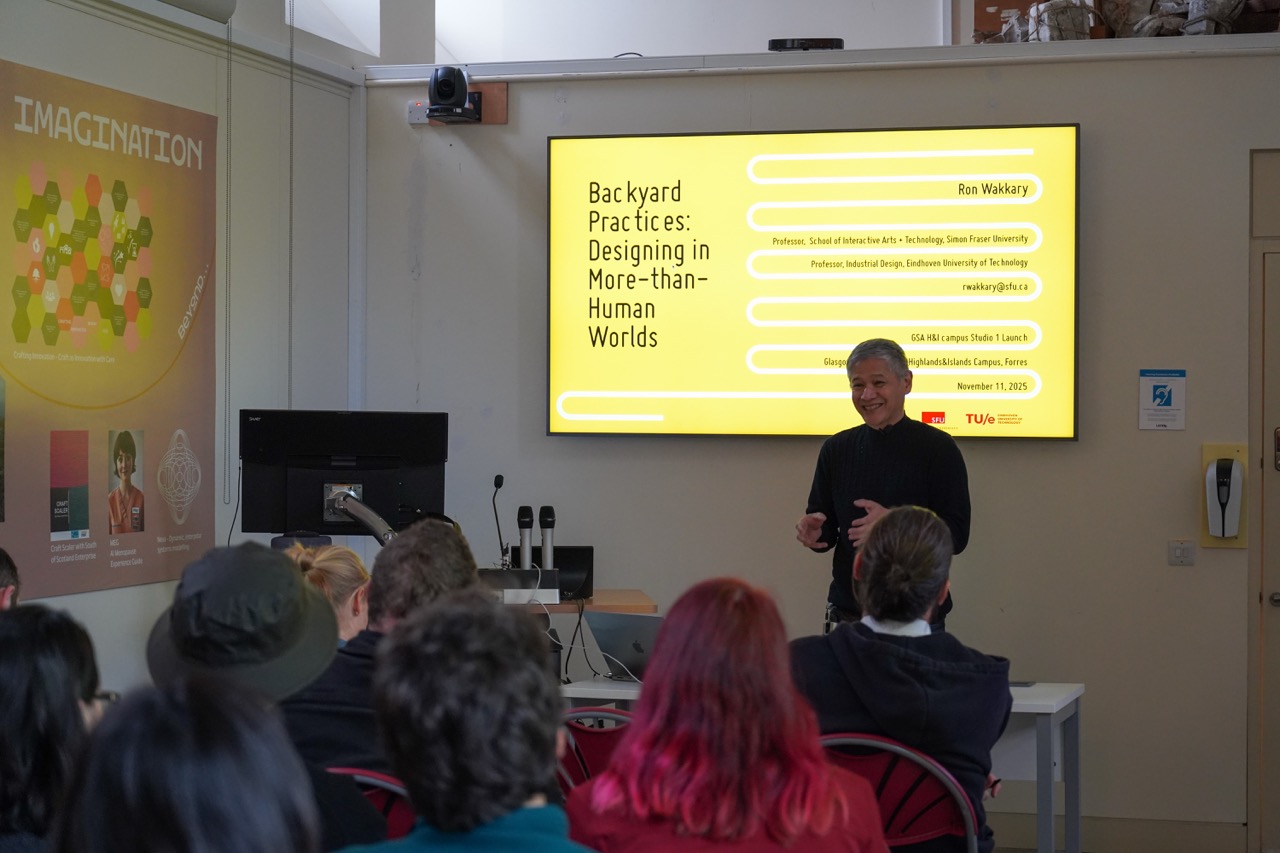
At the Highlands & Islands campus, Wakkary’s talk centred on the longstanding nature–culture divide and invited students to consider how design practices often reproduce assumptions that shape, and sometimes limit, our engagements with the environment. His lecture was followed by presentations from Bailee Allen and Adrianna Pouwer, graduates of the MDesDesign Innovation programmes (2024–25), who shared insights from their research projects. Together, the talk and presentations opened a wider conversation among students and staff about materiality, experimentation, and the responsibilities of designing in relation with the more-than-human, central concerns within the design innovation approach at the Highlands & Islands campus.
In Glasgow, his lecture discussed the challenges of sense-making in more-than-human contexts, noting the limits of human interpretation and the need to recognise the partial, situated nature of our understandings. Students then participated in an exciting discussion that raised questions about design’s impacts within the Anthropocene, ecological accountability, methodological humility, and the political implications of extending agency to non-human actors. This prompted a reflection on how design might evolve when non-human species are understood as participants in shared worlds rather than as resources - for example, the granting of legal personhood to the Magpie River in Wakkary’s home country of Canada.
Recent teaching within the Master of Design Innovation programmes has prepared students to engage with these themes. In the DesignFundamentals workshops earlier this semester, students explored what it means to design with, for, and through more-than-human worlds. They examined multispecies approaches alongside emerging questions around AI and technological actors, considering how materials, tools, systems, and computational agents shape design practices as collaborators rather than merely instruments. These investigations offered a strong foundation for students to critically connect with Wakkary’s propositions during his visit.
Professor Ron Wakkary’s visit offered an important opportunity for our postgraduate community to continue exploring how design can respond to the ethical, ecological, and societal demands of the present moment, and to imagine futures in which design practice is more attentive to the complexities of technologies and multispecies life.