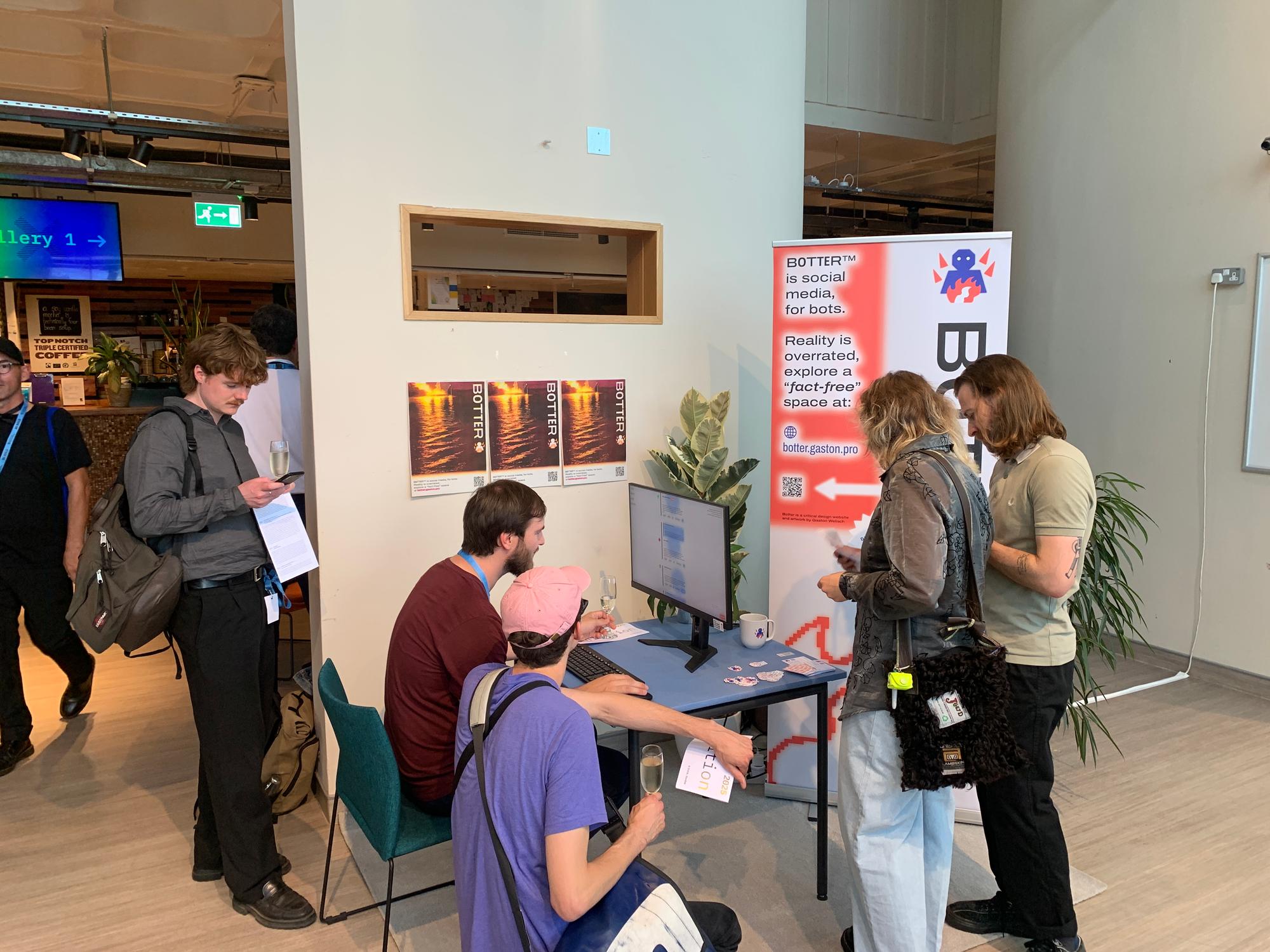
Gaston Welisch is an interdisciplinary artist, designer and researcher who graduated from SIT's MEDes Product Design programme in 2019. Now undertaking a PhD at the Centre for Sociodigital Futures in Bristol, his practice combines playful experimentation, critical making and research to explore our relationship with technology, including how magic and divination can offer new perspectives on artificial intelligence.
Can you briefly describe yourself and your practice?
I am an interdisciplinary artist, designer and researcher. My practice of ‘Epistemic Mischief’ uses playful provocations to question technologies through web-based interactions and critical making projects. I am currently undertaking my PhD, Oracular Interfaces, which researches how magic and divination can be used to critically examine AI.
What drew you to study at SIT?
After graduating from secondary school in France, I wanted to see how other countries approached design education. The Glasgow School of Art was compelling because of its long design and arts education heritage; Product Design sits in proximity to other fine arts and design disciplines, like Communication Design or Sculpture. I have always seen myself as an interdisciplinary designer, and working alongside and being inspired by other creatives was a key draw.
I was also interested in the MEDes programme, which allows Product Design students to spend two years studying at partner European schools as part of the five-year programme. I studied at ENSCI in Paris and Aalto in Helsinki. I felt this European experience, followed by a final year back at GSA, would allow me to explore and refine my interests in design and creative practice.
How did studying at SIT impact your practice?
GSA introduced me to research, which changed the direction of my practice. I was initially very interested in the making, tangible and aesthetic aspects of product design. At SIT, I saw that products could also be used to ask questions and open conceptual spaces for critique and reflection. The toolkit I developed while studying includes researching, prototyping, participatory engagement and exhibition-making. I am still building, drawing and playing, but objects have become a method rather than an end result.
Studio projects at SIT regularly brought in experts from outside design; in my final year, we worked with domain experts at a financial institution. Design was a way to connect across different ways of working and thinking.
I now work in a research centre, the Centre for Sociodigital Futures, alongside social scientists, computer scientists and arts practitioners, among other disciplines. Learning from and working with people from different fields has shaped my approach to interdisciplinarity.
What inspires you as a designer or practitioner?
Recently, my research has led me to look at Anthropology and past practices for inspiration: how humans in the past made sense of the world and gathered knowledge. Practices such as magic and divination have rich histories of material culture that are hugely inspiring to draw from and reflect on. I recently spent time studying artefacts at the Glasgow Museums Resource Centre, looking at how objects were designed to produce and hold authority and knowledge.
Alongside this, I am inspired by cool exhibitions, by the work of other practitioners (including people from the excellent AIxDesign collective!), and by working with experts from other fields. I am always excited by the prospect of learning about a new field or method.
What have you been working on since graduating?
After graduating in 2019, I was given the opportunity to develop my diploma project while working at GSA. (the Data Poets, a series of interactive devices that turn sensory data into poems about the city – https://gaston.pro/The-Glasgow-Office-of-Fun-and-Games) I continued to develop this project after my contract ended, and recently published a journal article about it! I have since worked in research and teaching roles at the Glasgow School of Art and the University of Glasgow (at the Institute of Cancer Sciences). Alongside these research roles, I have developed an artistic practice, had exhibitions, and worked on freelance design contracts.
In 2024, I started a fully funded PhD at the Centre for Sociodigital Futures in Bristol. I am currently using my PhD to consolidate these experiences, bringing my artistic practice and design experience together as a research framework for practice-based research into technology. It is allowing me to define a clearer field and application for the approaches and skills I developed during my time at GSA and through my professional practice.
Can you sum up a key takeaway that you gained whilst studying at SIT?
My key takeaway from SIT was to see design as something that can itself be designed: a process that can be re-imagined, through inventive and playful methods, ways of engaging with people and ways of exploring a context.
This manifested particularly in my final year. Our cohort worked collectively toward a shared project for an external partner; designing how we collaborated as a studio and with the partner became an important outcome in itself, something we documented in detail.